Branded Mobile App WiFi Onboarding: Architecture and Best Practices
When and how to use a custom mobile app to deliver secure, controlled Wi-Fi access — and how to avoid the common pitfalls that turn it into an ongoing maintenance burden.
A well-designed branded app can deliver a polished, controlled onboarding experience and reasonable security in environments where native certificate methods are difficult to deploy at scale. However, it introduces ongoing development, distribution, and security maintenance responsibilities that native EAP-TLS + Passpoint generally avoid. App-based onboarding is often a pragmatic tactical choice for complex BYOD, legacy device populations, or as a bridge strategy — but it should be evaluated against the long-term operational cost of maintaining the app over time.
The strongest implementations treat the app as a thin, secure delivery mechanism tightly integrated with a dedicated onboarding platform and existing identity infrastructure, rather than trying to build all the logic inside the app itself.
- • App-based onboarding can feel more branded and user-friendly than captive portals, but it carries ongoing app lifecycle costs that native methods largely eliminate.
- • The app should primarily authenticate the user and request profiles/credentials from a secure backend — not do the heavy cryptographic lifting itself.
- • Security depends heavily on proper use of platform secure storage, app signing, regular updates, and protection against reverse engineering.
- • Best results usually come when the app works alongside (not instead of) modern onboarding and PKI platforms.
- • Profile persistence after app deletion is a common gotcha — test thoroughly.
- • App solutions are often most valuable as an interim step while moving toward full Passpoint + EAP-TLS at scale.
When Branded App Onboarding Makes Sense
Organizations typically turn to a custom app when one or more of the following are true:
- High device diversity or legacy operating systems that have poor or inconsistent native 802.1X support.
- Strict MDM policies or limitations that prevent easy profile installation outside an approved app.
- Need for strong branding and a guided, controlled user journey (common in hospitality, education, or customer-facing environments).
- Requirement to combine Wi-Fi provisioning with other app features (loyalty, wayfinding, clinical tools, etc.).
- Desire for additional pre-connect steps such as terms acceptance, age verification, or payment before granting network access.
In pure enterprise environments with modern devices and good MDM coverage, native certificate methods (EAP-TLS delivered via a dedicated onboarding platform) are almost always preferable for security, roaming, and long-term maintenance reasons.

A branded app can guide users through authentication and profile installation while maintaining organizational control and visual identity.
Architecture Patterns
Most successful branded app implementations follow one of these patterns (or a combination):
The app handles user authentication (often against corporate IdP), then requests and installs a Wi-Fi configuration profile (or Passpoint profile) onto the device using platform APIs. The actual credentials or certificates are delivered securely and installed without the user manually entering anything.
The app acts as a secure proxy: it authenticates the user, obtains temporary or long-lived credentials/tokens from the backend, and passes them to the Wi-Fi supplicant or a companion onboarding component. Useful when direct profile installation is restricted.
In both cases, the heavy lifting (certificate issuance, profile generation with correct RCOI / NAI realms, policy enforcement) should live in a dedicated onboarding and PKI platform, not inside the mobile app. The app's job is primarily authentication, user guidance, and secure transport of the resulting configuration.
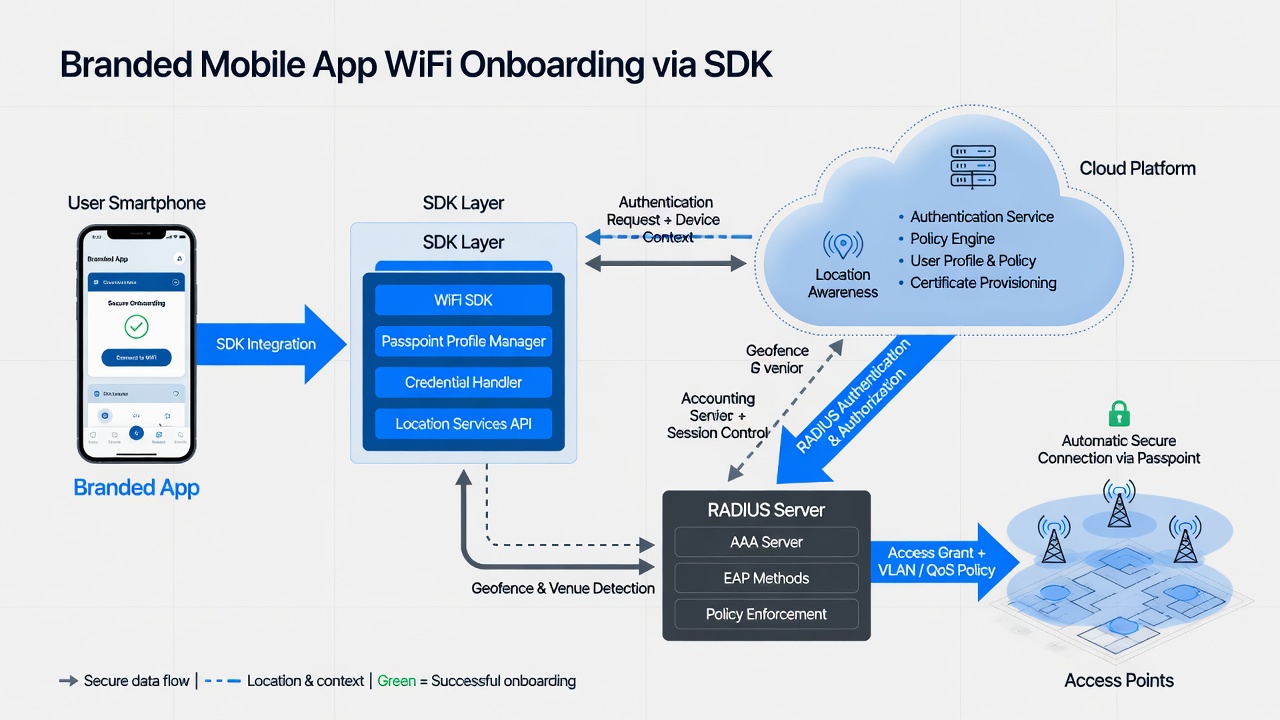
Best-practice architecture keeps complex certificate and profile logic in the backend onboarding platform while the app focuses on user experience and secure delivery.
Security Considerations
App-based onboarding introduces attack surfaces that native methods largely avoid. Address these explicitly:
- App integrity and updates: Use platform app signing, regular updates, and consider runtime integrity checks. An outdated or tampered app can undermine the entire onboarding chain.
- Credential and key storage: Always use platform secure storage (iOS Keychain, Android Keystore). Never store sensitive material in plain app storage or logs.
- Secure communication: All communication between app and backend must use strong TLS with proper certificate pinning where feasible.
- Reverse engineering protection: Obfuscate sensitive logic. Assume motivated attackers will decompile the app.
- Profile persistence: Test what happens if the user deletes the app. In many implementations, the installed Wi-Fi profile should remain functional.
- Data minimization and privacy: Only collect what is necessary. Be especially careful in regulated industries (healthcare, education, finance).
- App store and sideloading risks: Prefer official app stores. If sideloading is required, have strong distribution controls and update mechanisms.
Comparison to Native Certificate Methods
Native EAP-TLS delivered through a dedicated onboarding platform generally provides:
- Stronger cryptographic identity (device or user certificates) without relying on app code.
- Better long-term roaming behavior, especially with Passpoint and proper RCOI configuration.
- Lower ongoing maintenance — no app to update across OS versions and app stores.
- More consistent security model across iOS, Android, and other platforms.
App-based solutions can still be the right tactical choice when native methods are blocked by device policy, legacy hardware, or the need for very specific branded UX or additional pre-connect logic. Many organizations use apps as a bridge while they modernize their infrastructure and identity systems toward full Passpoint + EAP-TLS.
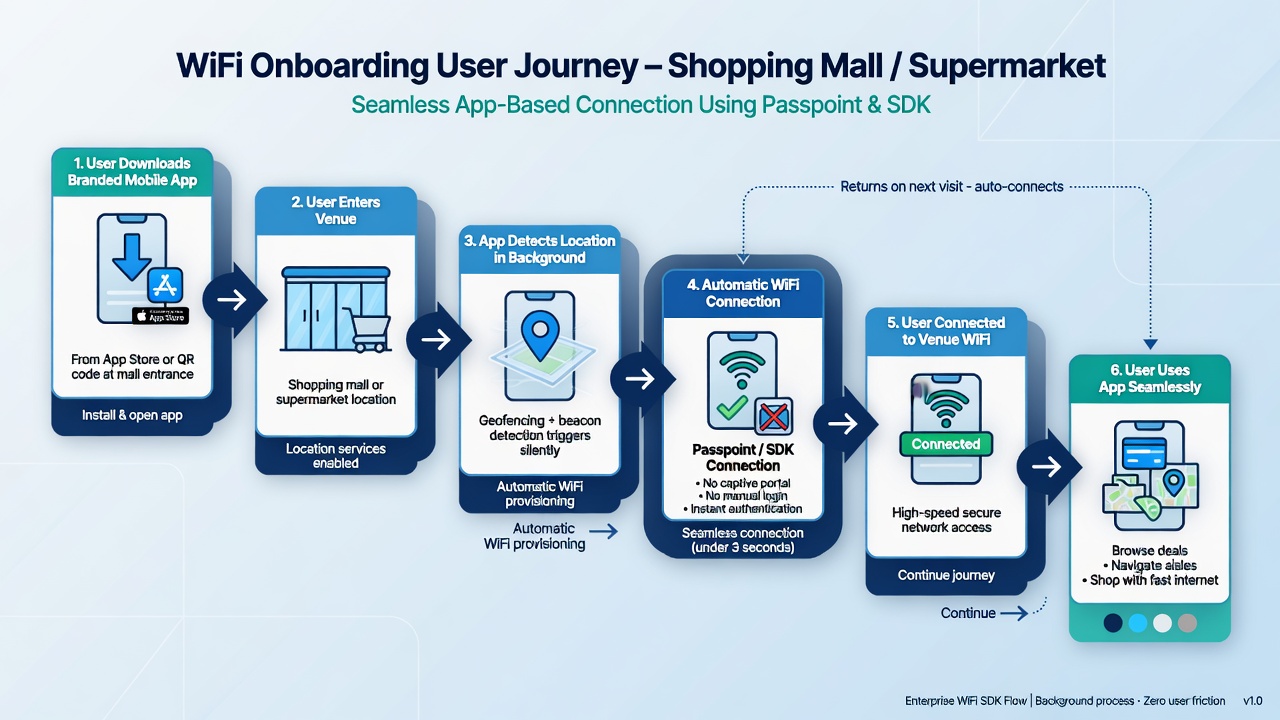
A good app guides the user through authentication and provisioning while keeping the underlying security mechanisms strong and backend-driven.
Key technical areas to evaluate and test:
- How the app handles certificate installation (if any) and whether profiles survive app deletion or OS updates.
- Integration points with your existing RADIUS/AAA, MDM/UEM, and identity provider.
- Support for advanced Passpoint profile attributes if you plan to move in that direction later.
- Cross-platform behavior (iOS vs Android, different OS versions, managed vs unmanaged devices).
- Logging and troubleshooting capabilities — can you diagnose onboarding failures without the user?
- App update and vulnerability management process and SLA.
- Whether the app can gracefully coexist with (or transition to) native certificate onboarding in the future.
Treat the app as a delivery vehicle, not the source of truth for credentials or policy. The real intelligence should live in your onboarding and PKI platform.
Branded mobile app Wi-Fi onboarding can be an effective, user-friendly solution when native methods are impractical. Its long-term success depends on treating the app as a thin, secure interface to a robust backend onboarding and PKI platform — not as a standalone security solution. Plan for ongoing maintenance, test thoroughly across platforms, and have a clear path toward stronger native methods (EAP-TLS + Passpoint) as your environment matures.
We help organizations decide when app-based onboarding makes sense and how to implement it securely and sustainably.