EAP-TLS Trust & Certificate Security for Modern Wi-Fi Networks
Why certificate-based authentication (EAP-TLS) provides fundamentally stronger security than passwords or pre-shared keys — and what “EAP-TLS trust” really means for clients, servers, and private CAs in 2026.
EAP-TLS is the strongest practical authentication method for Wi-Fi because the private key never leaves the device. Unlike passwords or PSKs, it provides mutual cryptographic authentication, immediate revocation, per-device or per-user identity, and excellent audit logging — all essential for zero-trust architectures. When implemented with a modern onboarding platform and proper certificate lifecycle management, it dramatically reduces the attack surface compared to legacy methods.
The security benefits are real, but they depend on correct trust configuration of the full chain: which CAs the device trusts for the RADIUS server, which client certificates the AAA accepts, how private CAs are installed on BYOD, and how revocation is checked. Misconfigured trust is a leading cause of “EAP-TLS doesn’t work on Android” tickets and failed migrations.
- • PSK and password-based Wi-Fi are inherently vulnerable to offline attacks, sharing, and phishing — once compromised, the secret is effectively public.
- • EAP-TLS keeps the private key on the device and provides strong mutual authentication between client and network.
- • EAP-TLS trust is two-way: the client must trust the RADIUS server certificate chain; the AAA must trust (and validate) the client certificate chain.
- • Private CA trust on consumer devices (especially Android) is a major operational risk without a dedicated multi-OS onboarding layer.
- • Revocation is fast and granular — lost or compromised devices can be blocked immediately without changing network-wide secrets.
- • Full audit logs of every authentication event support compliance and incident response.
- • Security depends on the entire chain: secure PKIaaS or on-prem CA, proper certificate templates, secure bootstrap, OCSP revocation checking, and device key protection.
- • When combined with Passpoint and a dedicated onboarding platform, EAP-TLS delivers both strong security and excellent user experience at scale.
Why Shared Secrets Are Fundamentally Insecure for Wi-Fi
Pre-shared keys (PSK) and username/password methods have well-known weaknesses that become critical at scale:
- Offline dictionary and brute-force attacks on captured handshakes.
- Easy sharing — once one person has the password, it spreads (whiteboards, Slack, email).
- No per-user or per-device identity — you can't tell who connected or revoke a specific person/device easily.
- No built-in mutual authentication — the client has no way to verify the network is legitimate (evil twin risk).
- Poor revocation — changing the PSK affects everyone and is operationally painful.
These issues are why standards bodies and regulators increasingly push toward certificate-based or token-based methods.
What “EAP-TLS Trust” Actually Means
When operators search for EAP-TLS trust, they are usually wrestling with one of these practical problems — not the abstract math of TLS:
- Server trust (client → network): The device must trust the certificate presented by the RADIUS/AAA server (or the issuing CA chain). Wrong trust anchors, incomplete intermediate chains, name mismatch, or expired server certs cause silent connection failures.
- Client trust (network → device): The AAA must validate the client certificate against allowed CAs, check revocation (OCSP/CRL), enforce EKU/key usage, and map certificate identity to authorization policy.
- Private CA on BYOD: Enterprise Wi-Fi often uses a private intermediate CA. Personal devices will not trust that CA until an onboarding flow installs the trust anchor (and the client cert) correctly per OS.
- Trust anchor hygiene: Overly broad trusted roots, expired intermediates left in profiles, or dual-trust periods during CA migration (including industry RADIUS CA changes) must be planned — otherwise you get intermittent “works on some devices only” behavior.
- Profile delivery: Trust material belongs in the same controlled profile as EAP method and SSID/Passpoint settings. Manual user install steps break at scale.
A dedicated onboarding platform’s job is to establish this trust correctly across iOS, Android, Windows, macOS, and ChromeOS — including over the public internet for pre-arrival enrollment — while AAA remains the policy engine that enforces server-side validation.
EAP-TLS Security Benefits (vs Passwords and PSK)
Both the client and the network prove their identity using certificates and private keys. The client verifies the server, and the server verifies the client.
Unlike a password that must be entered or a PSK that can be extracted, the private key is generated and stored securely on the device (or secure element) and never transmitted.
Each device or user can have a unique certificate. Revocation can be immediate via OCSP or CRL, without affecting other users.
Every authentication attempt is logged with certificate details, enabling detailed forensics and compliance reporting.
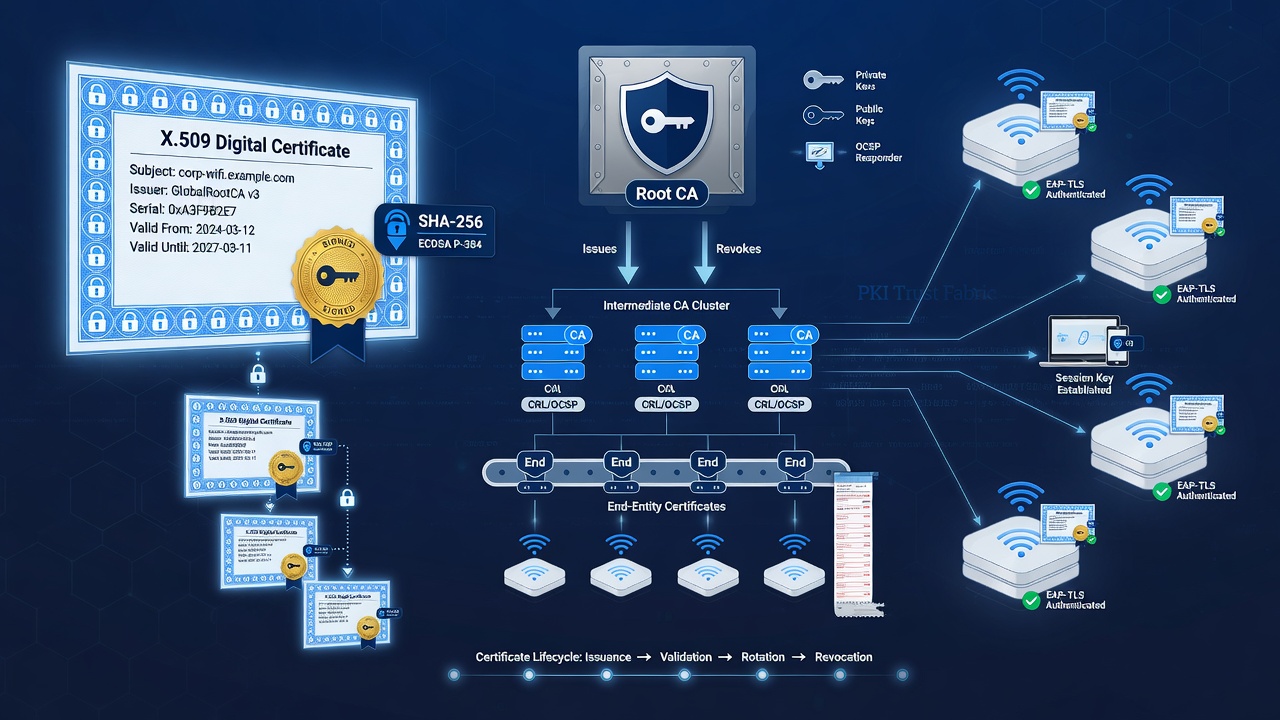
In EAP-TLS the private key stays on the device. This is fundamentally different from any shared-secret model.
Critical Implementation Areas for Strong Security
- Certificate Policy and Templates — Use dedicated templates for Wi-Fi client authentication with correct Key Usage and Extended Key Usage. Avoid overly permissive templates.
- Secure Bootstrap and Enrollment — How the device initially trusts the CA and obtains its certificate is often the weakest link. Use secure SCEP/EST with strong authentication of enrollment requests.
- Revocation and renewal — Prefer OCSP with short cache times. Ensure clients actually check revocation status. Automate revocation from identity and MDM systems. Plan certificate renewal before expiry so “my Wi-Fi stopped working” does not replace password resets as the dominant ticket type.
- Device-Side Key Protection — On modern devices, use platform secure storage (Keychain/Keystore) or hardware-backed keys. Never export private keys.
- Server-Side Validation — The RADIUS server must properly validate the client certificate (chain, revocation, name constraints, EKU) and reject anything that doesn't match policy.
- Monitoring and Logging — Log all authentication events with certificate details. Monitor for anomalous issuance or authentication patterns.
- Integration with Onboarding Platform — A dedicated onboarding layer is usually required to deliver certificates securely at scale, especially for BYOD and before devices join the network.
Specific technical controls to implement:
- Configure RADIUS servers to require client certificate validation and reject weak or expired certificates.
- Use OCSP stapling or must-staple where supported, and monitor OCSP responder availability.
- Regularly audit certificate templates used for Wi-Fi to ensure they meet current policy (key sizes, algorithms, validity periods).
- Implement certificate pinning or strict trust anchors on critical devices where feasible.
- Ensure the onboarding platform and PKIaaS (or on-prem CA) are integrated with your identity source for automated issuance and revocation.
- Test the full chain: enrollment, authentication, revocation, and roaming under realistic load.
- Log and alert on certificate issuance anomalies (possible attack or misconfiguration).
EAP-TLS security is only as strong as the weakest link in the certificate lifecycle and validation chain.
EAP-TLS provides cryptographic assurance that no password or PSK system can match. The private key stays on the device, authentication is mutual, revocation is immediate, and logging is comprehensive. These properties align directly with zero-trust principles. However, the security value is only realized when the full chain — policy, bootstrap, issuance, validation, revocation, and monitoring — is deliberately designed and operated. A modern onboarding platform plus PKIaaS (or well-run internal CA) makes this practical at scale.
We help teams design and validate secure EAP-TLS implementations backed by PKIaaS or on-premises infrastructure.