Scaling EAP-TLS WiFi with Cloud PKI Services: Technical Considerations
Production-grade guidance on enrollment throughput, identity synchronization, revocation propagation, monitoring, and architecture patterns when moving from pilot to tens or hundreds of thousands of devices with cloud PKI.
Scaling certificate-based Wi-Fi authentication to large environments exposes bottlenecks that simple pilots hide: enrollment endpoint capacity, identity synchronization latency, revocation propagation speed, and monitoring coverage. Cloud PKI platforms (PKIaaS) provide architectural advantages here — horizontal scaling, reliable OCSP, automated lifecycle, and APIs — but only when deliberately architected with a dedicated onboarding layer and your existing AAA infrastructure.
The organizations that succeed at scale design for high enrollment throughput, low-latency identity sync, fast revocation, and comprehensive observability from day one.
- • Enrollment throughput is often the first bottleneck — design for thousands of devices per hour, not per day.
- • Identity synchronization latency directly impacts time-to-connect for new or re-provisioned devices.
- • Revocation must be near real-time at scale; OCSP with short caching is usually required.
- • Monitoring certificate issuance rates and anomaly detection is essential for both operations and security.
- • The combination of PKIaaS + a dedicated onboarding platform is what makes true scale practical on existing infrastructure.
- • Client-side queuing, retry logic, and backoff are as important as server-side scaling.
Core Scaling Dimensions
Moving from hundreds to tens of thousands (or more) devices changes the operational profile of a PKIaaS + EAP-TLS deployment. The key dimensions are:
How many certificates can be issued per hour/day during mass onboarding events (new school year, hospital expansion, corporate refresh).
How quickly changes in your identity source (HR system, IdP) are reflected in certificate eligibility and attributes.
How quickly a revocation becomes effective across the network (critical for lost devices or terminated staff).
Enrollment Performance and Architecture
PKIaaS platforms are designed for scale, but real-world throughput depends on how you use them.
Best practices observed in large deployments:
- Use SCEP or EST with proper queuing and retry logic on the client/MDM side. Do not assume every device will succeed on the first attempt.
- Implement backoff and rate limiting on the client to avoid thundering herd problems during mass onboarding events.
- Design your onboarding platform to spread enrollment load over time where possible (pre-provisioning before devices arrive).
- Monitor enrollment success rates, latency, and error codes in real time. Spikes in failures often indicate identity sync issues or misconfigured templates.
- Consider geographic distribution or load balancing of enrollment endpoints if you have large remote populations.
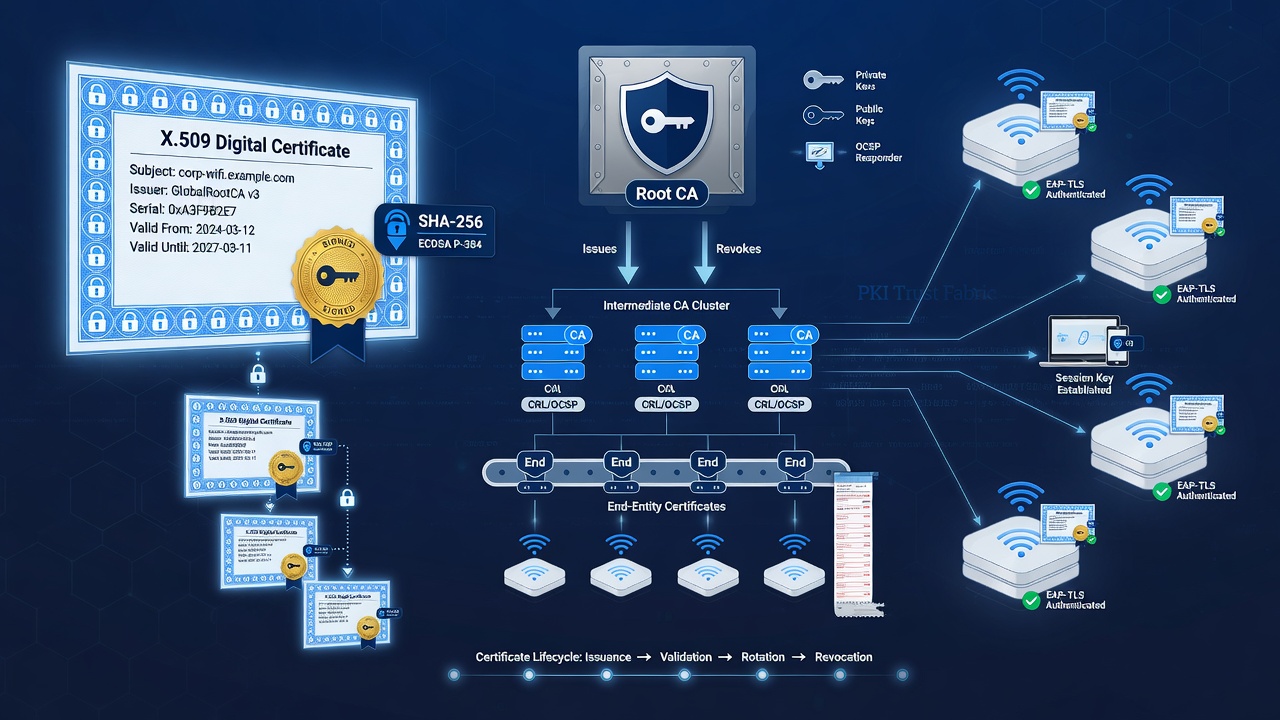
Horizontal scaling of enrollment services and intelligent client retry logic are essential for handling mass onboarding events without overwhelming the PKIaaS platform.
Identity Synchronization at Scale
Certificate eligibility and attributes should reflect your source of truth (Active Directory, HR system, IdP, MDM, etc.).
Key considerations:
- Low-latency sync is critical for new hires, contractors, and students who expect to connect on day one.
- Automate revocation on termination events. Manual processes break at scale.
- Support for both user and machine certificates when required (common in enterprise and healthcare).
- Handle identity changes cleanly (name changes, department moves) without creating duplicate or orphaned certificates.
- Use attributes from the identity source to drive advanced policy (e.g., department, role, location) that can be expressed in Passpoint profiles or network policies.
Revocation at Scale
At large scale, revocation must be fast and reliable.
Recommendations:
- Prefer OCSP with short cache times over CRLs for Wi-Fi clients.
- Ensure your PKIaaS provider offers reliable, highly available OCSP and that your clients are configured to use it.
- Automate revocation triggers from identity sources and MDM platforms.
- Monitor OCSP responder health and response times.
- Have a documented process for emergency mass revocation (e.g., major device compromise scenario).
Monitoring, Observability, and Alerting
At scale you need visibility you didn’t need in pilot.
Monitor at minimum:
- Certificate issuance rates and success/failure ratios
- Enrollment latency percentiles
- Revocation events and OCSP response health
- Authentication success rates correlated with certificate issuance (via your AAA/SIEM)
- Anomalies (sudden spikes in issuances, unusual error patterns, certificates issued for unexpected device types)
Feed these into your existing monitoring and security tooling. Unusual certificate issuance patterns can be an early indicator of compromise or misconfiguration.
Additional technical considerations for production scale:
- Design client/MDM enrollment with exponential backoff and jitter to protect the PKIaaS endpoints.
- Use separate certificate templates (or policies) for different populations to simplify troubleshooting and policy changes.
- Implement certificate pinning or strict validation where appropriate on high-value devices.
- Test revocation end-to-end regularly, including under load.
- Plan for “thundering herd” events (new school year, hospital go-live, corporate refresh) and pre-provision where possible.
- Document your certificate policy and template standards clearly — this becomes critical when you have multiple teams or vendors involved.
The strongest large-scale deployments treat the PKIaaS service as one component in a larger system that includes your onboarding platform, identity source, AAA, and observability stack.
Cloud PKI services remove many of the traditional scaling barriers of on-premises PKI, but achieving reliable performance at tens or hundreds of thousands of devices still requires deliberate architecture. Focus on enrollment throughput, low-latency identity sync, fast revocation, and comprehensive monitoring from the beginning. When PKIaaS is combined with a capable dedicated onboarding platform, these technical considerations become manageable on infrastructure you already own.
We help organizations design scalable PKIaaS + onboarding architectures for large Wi-Fi environments.