What is PKI as a Service (PKIaaS) and Why It Matters for WiFi
Public Key Infrastructure as a Service — cloud-managed PKI that removes one of the largest historical barriers to scaling secure, certificate-based Wi-Fi authentication (including EAP-TLS as a cloud-backed SaaS model) on infrastructure you already own.
PKI as a Service (PKIaaS) — sometimes described informally as cloud PKI or the certificate half of an “EAP-TLS SaaS” stack — delivers certificate issuance, lifecycle management, and revocation as a cloud service. For Wi-Fi projects this is transformative because it eliminates the need to build, operate, and maintain an internal enterprise certificate authority — one of the most common reasons large EAP-TLS and Passpoint initiatives stall or get scoped down.
When paired with a dedicated onboarding platform, PKIaaS enables fast, secure, policy-rich certificate delivery to staff devices, BYOD, guests, and IoT at scale — all while integrating with your existing RADIUS/AAA infrastructure. The result is stronger security, lower operational cost, and dramatically faster time to production. Note: PKIaaS issues and manages certificates; the full production path still needs multi-OS onboarding and AAA policy — not certificates alone.
- • Running your own PKI for Wi-Fi is complex, expensive, and rarely a core competency.
- • PKIaaS shifts certificate operations to specialists with automated, internet-accessible enrollment (SCEP/EST).
- • The biggest value appears when PKIaaS is combined with a modern onboarding layer that can deliver advanced Passpoint profiles (including RCOI) at scale.
- • Most organizations already have the Wi-Fi hardware needed; PKIaaS + onboarding removes the last major blocker.
- • Cost predictability improves and risk decreases compared with maintaining brittle internal CAs.
- • Proper integration with your existing AAA (Cisco ISE, Aruba ClearPass, etc.) is essential — PKIaaS is not a replacement for AAA.
What PKI as a Service Actually Is
Public Key Infrastructure (PKI) is the system of policies, processes, and technology that issues, manages, and revokes digital certificates used for authentication and encryption.
In a traditional on-premises model, your organization owns and operates the certificate authority (CA), hardware security modules (HSMs), databases, and all the surrounding processes. This is operationally heavy and requires specialized expertise that most IT and network teams do not have as a core skill.
PKI as a Service moves the CA into the cloud and provides it as a managed service. You define the policies; the provider handles the infrastructure, high availability, patching, compliance certifications, and much of the day-to-day operations.
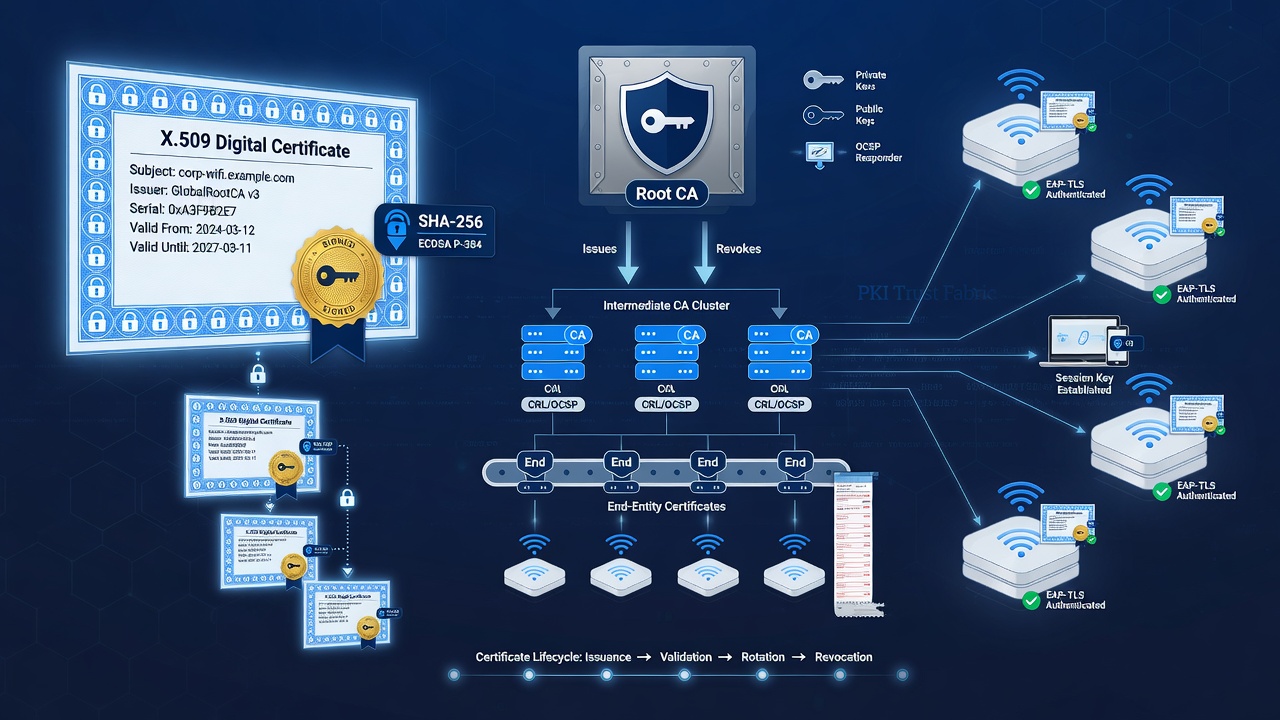
Modern PKIaaS platforms expose simple enrollment interfaces (SCEP, EST) that integrate cleanly with device onboarding tools and MDM systems.
Why This Matters Specifically for WiFi
Wi-Fi authentication at scale (especially EAP-TLS and advanced Passpoint) is one of the use cases that most exposes the weaknesses of on-prem PKI:
- High volume of certificate requests from phones, laptops, tablets, and IoT
- Need for internet-reachable enrollment so devices can be provisioned before they ever join the corporate network
- Requirement for advanced profile attributes (RCOI for Passpoint roaming, specific NAI realms, etc.)
- Frequent need for rapid revocation when devices are lost or staff leave
- Desire for predictable OPEX instead of unpredictable capital and staffing costs
PKIaaS platforms are purpose-built for exactly these patterns. They typically offer pre-configured, highly available SCEP and EST endpoints, automated renewal, rich APIs, and integration hooks that make large-scale Wi-Fi certificate deployments practical.
How PKIaaS Works With Your Existing Infrastructure
One of the most common misconceptions is that adopting PKIaaS means ripping out your existing RADIUS or AAA system. In reality the opposite is usually true.
A modern PKIaaS solution acts as the certificate authority that your existing AAA (Cisco ISE, Aruba ClearPass, Microsoft NPS, FreeRADIUS, etc.) trusts. The onboarding platform talks to the PKIaaS service to request and deliver certificates, while your AAA continues to make the actual authentication decisions.
This separation of concerns is powerful: you keep control of policy and access decisions in your AAA while outsourcing the complex, specialized work of certificate management to experts.
Key Considerations and Trade-offs
- • Dramatically lower operational overhead
- • Faster time to production for EAP-TLS and Passpoint
- • Predictable pricing and strong SLAs
- • Professional security operations and compliance certifications
- • Easy integration with cloud identity providers
- • Trust model and root CA transparency
- • Ability to meet your specific certificate policies and naming requirements
- • Integration depth with your existing AAA and identity systems
- • Data residency and contractual terms
- • Exit strategy and certificate portability
When evaluating or implementing PKIaaS for Wi-Fi, pay close attention to:
- Support for both SCEP and EST (and ideally ACME) so you have flexibility across device types and MDMs.
- Ability to include advanced Passpoint attributes (RCOI, NAI realms, venue information) inside the certificates or profiles delivered to devices.
- Integration hooks with your RADIUS/AAA for real-time revocation status (OCSP or CRL).
- Logging and auditing capabilities that satisfy your compliance and SIEM requirements.
- Support for both user and machine certificates when your environment needs both.
- Clear separation between the PKIaaS service and any onboarding layer — they are complementary but distinct.
The strongest deployments treat PKIaaS as the specialized engine for certificate operations while the onboarding platform handles the user/device experience and profile distribution logic.
For most organizations, PKI as a Service is the pragmatic way to achieve secure, scalable Wi-Fi authentication without taking on the full burden of running production PKI. When combined with a dedicated onboarding solution that can leverage the PKIaaS service to deliver rich profiles (including Passpoint RCOI values), the combination removes the last major barrier between “we have 802.1X” and “our Wi-Fi is fast, secure, and actually used at scale.”
We help organizations evaluate PKIaaS options and design the right integration with their existing infrastructure.