Legacy Reality: Shared SSIDs + EAP-PEAP at University Scale
Many campuses still operate on one or more persistent SSIDs protected by EAP-PEAP (or similar password-tunneled methods). Users authenticate with institutional credentials, but the model inherits the classic problems of password-based systems at massive BYOD volume:
- High volume of password reset, lockout, and “can’t connect” tickets, especially during move-in, exam periods, and device churn.
- Shared or easily guessed credentials in practice for some populations, increasing risk of credential stuffing and lateral movement if accounts are compromised.
- Manual or semi-manual onboarding that frustrates users and consumes staff time.
- Difficulty enforcing consistent policy or strong encryption across every personal device.
- Compliance and audit friction because password-based auth is weaker evidence of control than certificate-based mutual authentication.
These issues are well known, but the full downstream costs — especially lost student engagement and retention — are rarely quantified in Wi-Fi business cases.
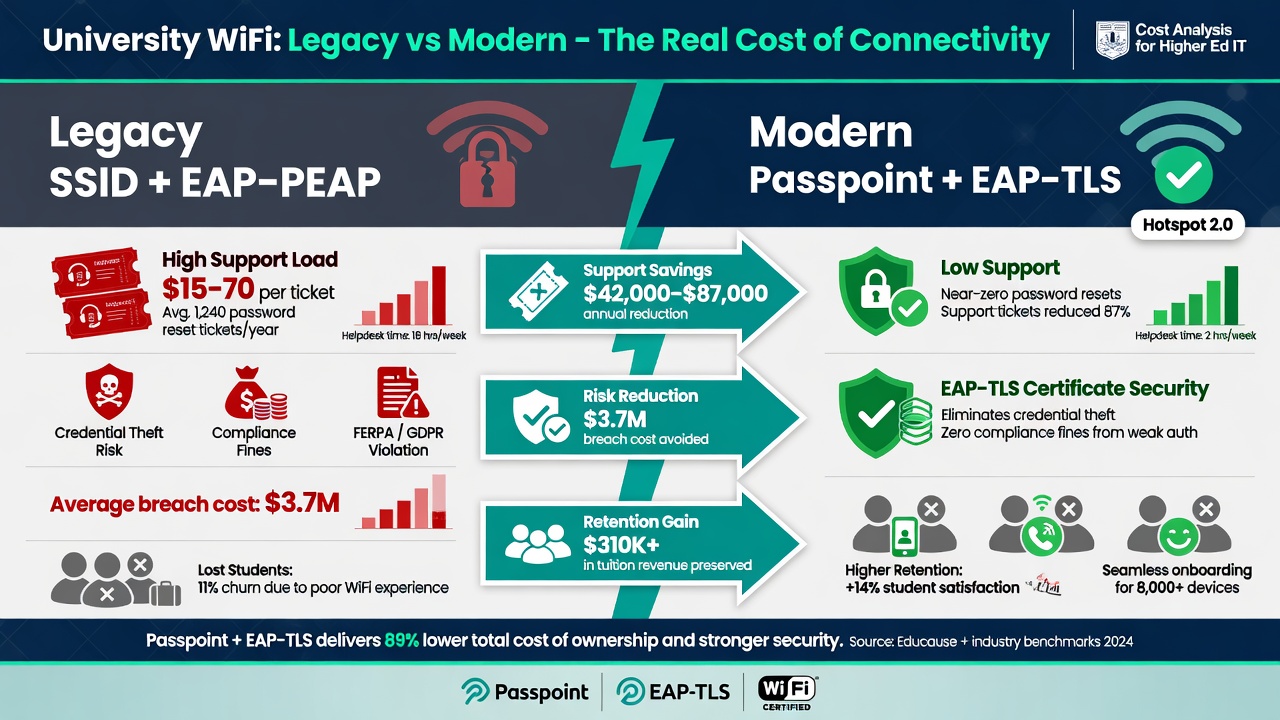
Typical cost and risk profile shift when moving from legacy password-based SSIDs to Passpoint-enabled certificate authentication at campus scale.
Modern Approach: Passpoint + EAP-TLS
Passpoint (Hotspot 2.0) combined with EAP-TLS certificate authentication changes the economics. Devices automatically discover and join the correct secure network using policy-rich profiles. Authentication is mutual and cryptographic — no passwords traverse the air or get phished from a fake portal.
The heavy lifting of profile creation, certificate issuance, and delivery at scale is handled by a dedicated onboarding and dynamic PKI platform that works with your existing AAA (Cisco ISE, ClearPass, etc.). Students and staff complete enrollment once (ideally before arrival or over the public internet) and then experience seamless, secure connectivity across campus and, with OpenRoaming federation, far beyond it.
This is not a rip-and-replace of your radios or policy engine. It is the missing client-side and PKI layer that makes the modern standard practical for real university populations.
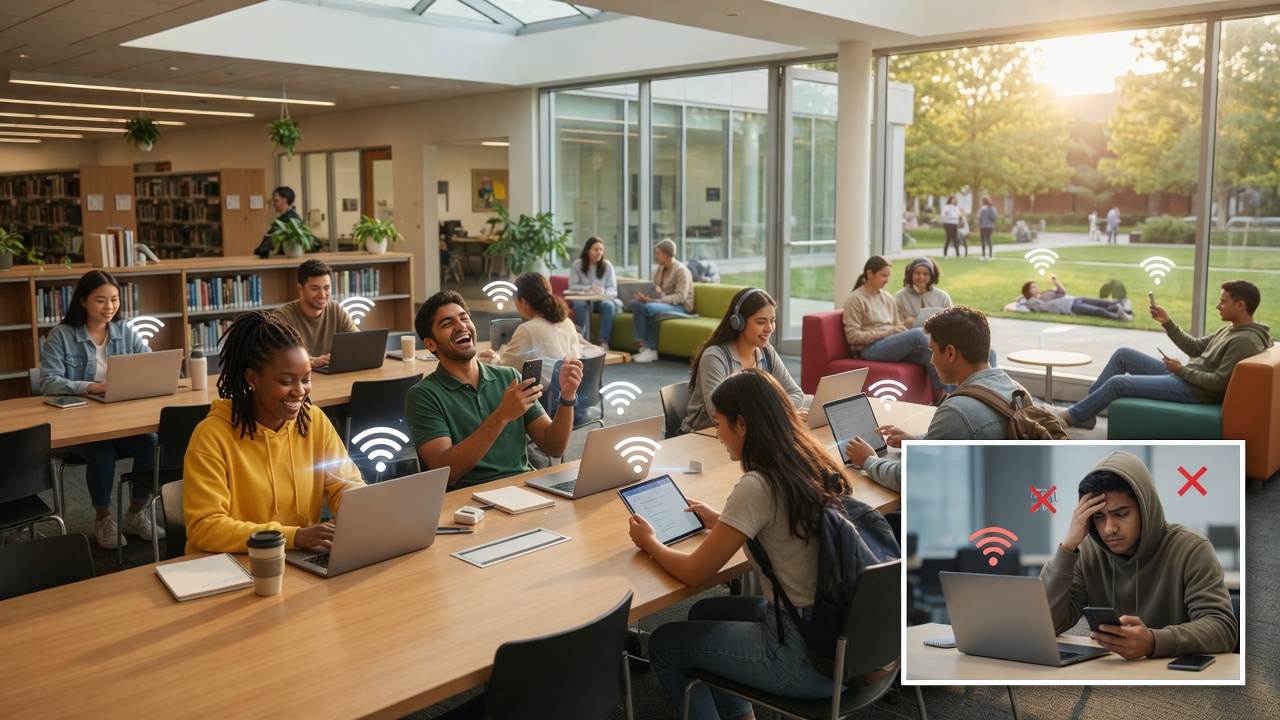
Reliable, automatic connectivity supports academic success and helps keep students engaged with campus life.
Quantified Cost Savings
1. Helpdesk and Support Reduction
Password-related and onboarding tickets dominate legacy Wi-Fi support. Industry estimates place the fully loaded cost of a single password reset or connectivity ticket between $15 and $70. In a large university with frequent device turnover and password policies, this quickly adds up to hundreds of thousands of dollars annually in staff time.
Modern EAP-TLS with proper onboarding shifts the ticket profile dramatically: one-time enrollment instead of recurring resets, automated renewal, and far fewer “can’t connect” issues because the profile handles discovery and trust. Organizations adopting this model commonly report 65–85% sustained reductions in Wi-Fi related tickets once the initial transition is complete.
2. Cybersecurity Risk and Compliance
PEAP and similar methods are susceptible to credential interception, evil-twin attacks, and weak password practices. In the education sector, the average cost of a data breach is approximately $3.7 million (IBM data), with additional regulatory, legal, notification, and reputational costs. Weak Wi-Fi auth can be a contributing factor in investigations and can complicate compliance with standards that expect strong authentication controls.
EAP-TLS with certificates provides mutual authentication, per-device revocation, and eliminates password transmission. This materially lowers the attack surface and provides stronger audit evidence. When paired with Passpoint’s network verification, the risk of users connecting to rogue networks also decreases. The avoided cost of even one significant incident or major audit finding can exceed the entire investment in modern tooling.
3. Student Retention and Campus Engagement
This is the largest and most under-modeled category for universities.
Direct revenue loss per student who does not complete or re-enrolls elsewhere is substantial: roughly $10,000–$21,000+ in tuition and fees for a four-year institution in the US (higher in some private or international markets), plus the cost of recruiting a replacement student. Sector-wide attrition costs run into the hundreds of millions in major markets.
Studies consistently link unreliable or frustrating campus and home connectivity to lower academic performance, reduced engagement, higher stress, and lower satisfaction — all factors associated with increased dropout risk. Poor Wi-Fi is not the only reason students leave, but it is a controllable environmental factor that affects daily experience and study capability.
Illustrative math for a mid-sized university (say 15,000–20,000 students, 8–12% attrition): if even a small percentage of departures are influenced by connectivity friction (e.g., inability to reliably access learning platforms, submit work, or stay connected socially), the annual revenue impact can reach hundreds of thousands to low millions — before adding recruitment, housing, and downstream effects.
Modern seamless Wi-Fi (Passpoint + EAP-TLS) reduces this friction. Students stay productive, feel supported by the institution, and are more likely to remain engaged with campus resources and community. The mining-industry anecdote of a single high-value worker costing hundreds of thousands due to isolation from poor connectivity has a direct parallel in education: each student represents significant tuition revenue plus lifetime alumni value. Protecting that relationship through reliable access has real financial weight.
ROI Timeline and Realistic Modeling
Most institutions see the support and risk reductions pay for the onboarding/PKI layer within 12–24 months. Retention benefits, while harder to attribute precisely, can move the needle significantly because the per-student revenue at stake is large relative to per-user Wi-Fi tooling costs (often in the low single digits per device per year at scale).
Key variables for your model:
- Current Wi-Fi ticket volume and average resolution cost.
- Security incident history or audit findings tied to authentication.
- Baseline attrition rate and any correlation with student feedback on technology.
- Cost of the dedicated onboarding + PKI platform at your volume (typically decreasing sharply with scale and education discounts).
The shift from legacy SSID + EAP-PEAP to Passpoint + EAP-TLS is not primarily an infrastructure project. It is an operational and risk-reduction project that leverages the Wi-Fi hardware you already own. When modeled honestly — support tickets, breach exposure, compliance overhead, and the revenue tied to keeping students successfully engaged — the savings and avoided costs are substantial and recurring. A dedicated onboarding platform is the practical mechanism that makes the modern standard deliverable at university scale without creating new operational burdens.