WiFi Analytics for Business: Network Insights, Reporting & Integrations
Business leaders and IT ops teams need more than signal strength charts. This guide covers WiFi analytics for business — network connection analytics, managed reporting, integrations, and the metrics that drive real decisions.
Modern Wi-Fi platforms generate rich data on client experience, RF health, security events, and user behavior. Organizations that treat this telemetry as a strategic asset gain better capacity planning, proactive issue detection, measurable ROI on infrastructure investments, and — for venues — powerful first-party insights for marketing and operations. However, raw data alone delivers little value without clear use cases, integration with existing tools, and disciplined privacy practices.
For business stakeholders, “WiFi analytics” means connection success, time-to-connect, experience scores, and reporting that explains whether the network supports operations and guests — not only RF heatmaps. The highest-performing teams focus on a handful of high-impact metrics and pair vendor dashboards with export to broader observability and BI platforms.
- • WiFi analytics for business turns wireless from a cost center into operational intelligence — and, in many venues, consented first-party customer insight.
- • Network connection analytics (association success, auth success, roam quality, time-to-connect) matter more to executives than raw channel utilization alone.
- • Focus on a few high-value use cases: experience, capacity, security, and business outcomes rather than boiling the ocean.
- • Managed WiFi analytics and reporting should export to SIEM, ITSM, and BI tools — vendor-only dashboards are rarely the full picture.
- • Privacy and consent are non-negotiable; demographics and marketing use cases require clear opt-in and data minimization.
- • Integrations (MDM, EDR, CRM, PMS, identity) multiply value; wireless data in isolation under-delivers.
- • Good analytics programs pay for themselves through reduced troubleshooting time and better-informed upgrade decisions (including Wi-Fi 7 readiness).
Why WiFi Analytics for Business Matters Now
Access points and controllers produce detailed data on associations, roaming, airtime, errors, and — increasingly — application-level performance and location. When properly collected, normalized, and acted upon, this data helps IT teams move from reactive firefighting to proactive optimization. For business owners of venues, campuses, and multi-site enterprises, the same signals answer different questions: Are guests connecting? Is peak hour capacity enough? Did the modernization project improve experience and cut tickets? In venues, consented visitor patterns also support operations and marketing.
Network Connection Analytics: What to Measure
When searchers look for “network connection analytics” or “wireless network analytics,” they usually mean the path from discovery to usable connectivity:
- Connection success rate — percentage of attempts that reach authenticated, IP-assigned, usable state.
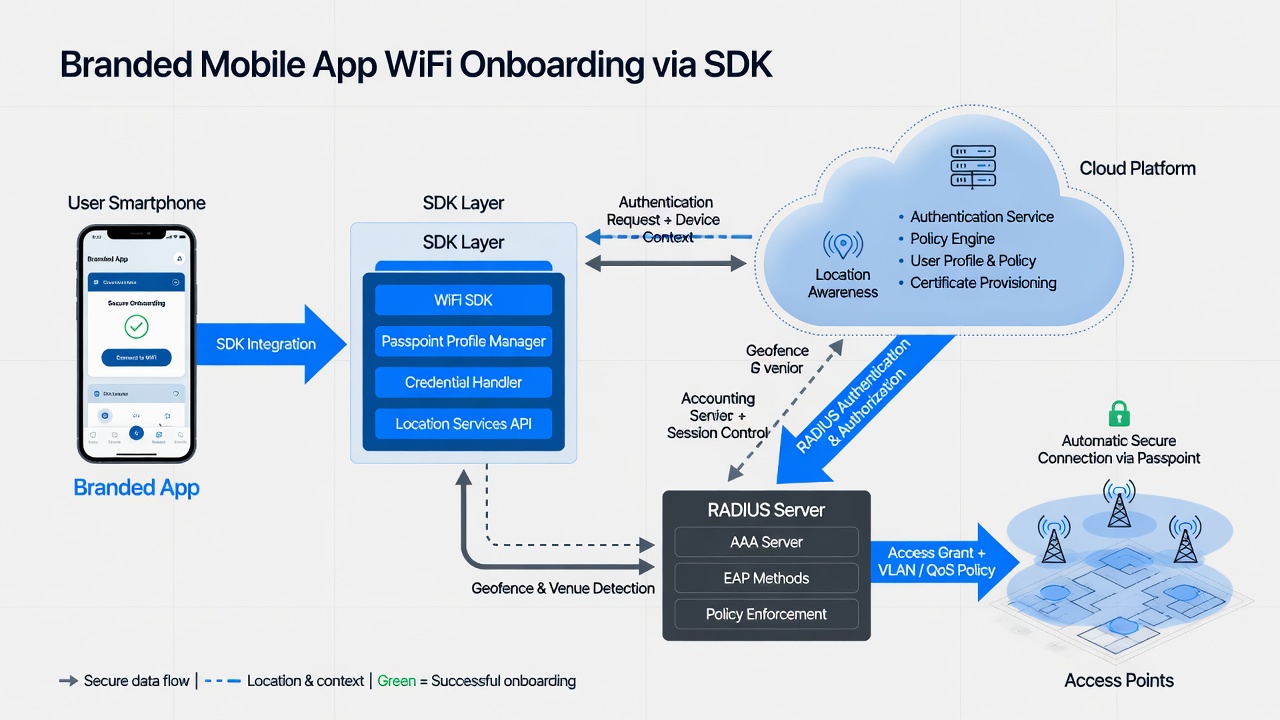
- Time-to-connect — seconds from association start to working network (especially important after EAP-TLS or Passpoint onboarding changes).
- Authentication and re-authentication patterns — failures by EAP method, OS, location, or time of day.
- Roam quality — sticky clients, failed fast transitions, and session drops during movement.
- Experience correlation — whether connectivity problems map to application or ticket spikes.
These metrics sit above pure RF health and are the language business stakeholders understand.
Core Categories of Metrics That Matter
- Client Experience: Success rates for connection and roaming, time-to-connect, signal strength trends, and application performance indicators.
- Capacity and RF Health: Channel utilization, client density, airtime distribution, interference sources, and predictive capacity alerts.
- Security and Compliance: Authentication success/failure patterns, rogue device detection, anomaly detection, and policy violation logs.
- Business and Operational Outcomes: Dwell time, repeat visit patterns (where consented), correlation with service desk tickets, and before/after metrics for modernization projects.
High-level flow: Wi-Fi data → export to SIEM/analytics + consented marketing/CRM systems.
Practical Use Cases Executives Care About
Successful programs pick 3–5 use cases and instrument ruthlessly for them:
- Predicting and preventing capacity issues before complaints arrive.
- Quantifying the experience improvement (and helpdesk reduction) after upgrades.
- Identifying “sticky client” problems that point to configuration or device issues.
- For venues: consented first-party insights into visitor flows, dwell time, and loyalty program engagement.
Managed WiFi Analytics, Reporting & Integrations
Enterprise teams rarely live inside a single wireless controller UI. A durable analytics program treats reporting and integrations as first-class design:
- Operational reporting — weekly connection success, top failure sites, certificate/EAP error trends, capacity headroom by building.
- Business reporting — venue dwell (where consented), peak utilization vs. events, before/after modernization KPIs.
- Integrations — stream or export to SIEM/observability (security + incident response), ITSM (ticket correlation), identity (auth context), and BI tools for leadership dashboards.
- Corporate WiFi insights vs. demographics — RF and connection quality are always in scope; demographic-style analytics only with clear consent, purpose limitation, and data minimization. Never conflate “network health” with personal marketing data without governance.
Honest Limitations and Trade-offs
Analytics is powerful but not magic. Vendor dashboards can be siloed. Privacy regulations limit what can be collected and used for marketing. Over-instrumentation creates noise and storage costs. The biggest wins usually come from tight integration with other data sources rather than Wi-Fi data in isolation.
Plan for data export (syslog, streaming, or APIs) to Splunk, Elastic, Datadog, or your cloud SIEM early. Define retention, sampling, and alert thresholds before you have too much data. Correlate wireless events with endpoint posture (MDM/EDR) and identity systems. For marketing use cases, ensure consent flows are clean and data is minimized. Test your ability to reconstruct “what happened” during a major incident using the data you actually retain.
If you want to move from “we have some dashboards” to a program that actually drives decisions and (where appropriate) business value, request a consultation. We can review your current telemetry maturity, integration gaps, and quick wins for both operations and consented guest insights.