2026 RADIUS CA Migration: What Large Organizations and Universities Must Know About Certificate Authority Changes
A practical guide to the industry-wide shift in trusted certificate authorities for EAP-TLS and how to avoid mass device disconnects in BYOD environments.
In 2026, organizations using RADIUS-based authentication (especially EAP-TLS for certificate-based Wi-Fi) face mandatory updates to the certificate authorities their infrastructure and client devices trust. For environments with thousands of personal devices, this creates a high-risk re-enrollment event. Many pure AAA deployments will struggle with the scale and user friction. Dedicated onboarding platforms that can push updated profiles over the public internet — combined with careful dual-trust planning — turn a potential crisis into a manageable project.
Universities, healthcare systems, and large enterprises should treat this as a 2025–2026 priority alongside any Wi-Fi 7 or zero-trust initiatives. The cost of poor planning is mass support tickets and lost productivity when devices suddenly lose network access.
- • A significant number of RADIUS deployments will need to update trusted CAs in 2026, with specific cutover dates that will break devices using old profiles.
- • BYOD populations are the highest risk — manual re-enrollment or on-campus-only processes will not scale for 10k–100k devices.
- • Internet-accessible onboarding platforms allow preemptive bulk profile updates from anywhere, dramatically reducing the blast radius.
- • Dual-trust periods (supporting both old and new CAs temporarily) are essential but add complexity to testing and rollback planning.
- • Organizations already using or planning a dedicated onboarding layer paired with their existing AAA (ISE, ClearPass, etc.) are far better positioned than those relying solely on native portals.
- • Budget for both technical work (profile updates, testing) and change management (communicating to users and helpdesk).
- • This is a forcing function to finally move more devices to full certificate-based auth — the migration pain is actually lower with proper EAP-TLS tooling than with legacy credential methods in many cases.
What Is the 2026 RADIUS CA Migration?
Public and private certificate authorities periodically update their root and intermediate certificates. When a widely used CA root is scheduled for deprecation, RADIUS servers and the devices that connect to them must be updated to trust the replacement. In 2026, several major shifts in trusted CAs for 802.1X/RADIUS infrastructure are coming to a head.
Devices that were onboarded with profiles referencing the old chain will fail authentication after the cutover date unless their profiles are updated to include the new trust anchors.
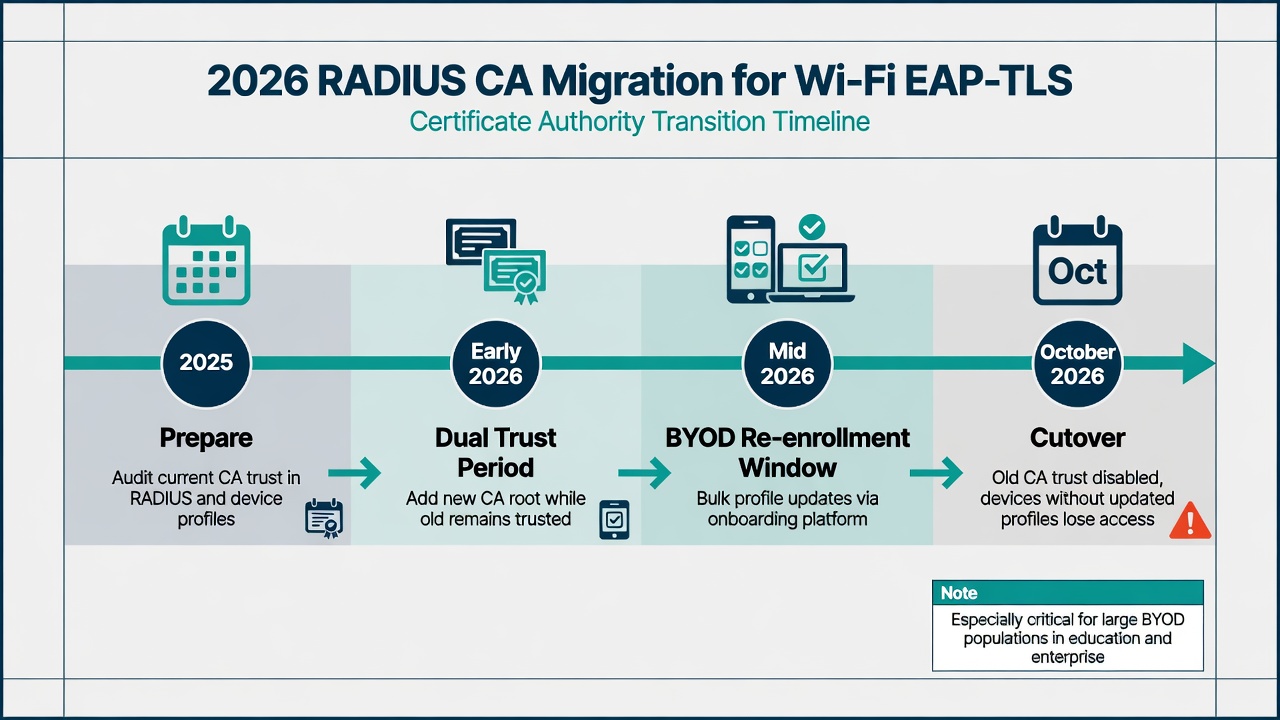
High-level 2026 migration timeline — preparation in 2025 is critical for large BYOD environments.
Why This Hits Large BYOD Environments Especially Hard
Corporate-managed devices can often have new profiles pushed silently via MDM. Personal devices (the majority in universities and many enterprises) rely on self-service or one-time onboarding. If that onboarding was done against the old CA chain, those devices become "orphaned" after cutover.
- Thousands of students or employees may suddenly lose Wi-Fi access with no obvious error message.
- Helpdesk volume will spike if there is no automated path to re-enroll.
- Many older profiles were created with captive portals or manual processes that are no longer easily repeatable at scale.
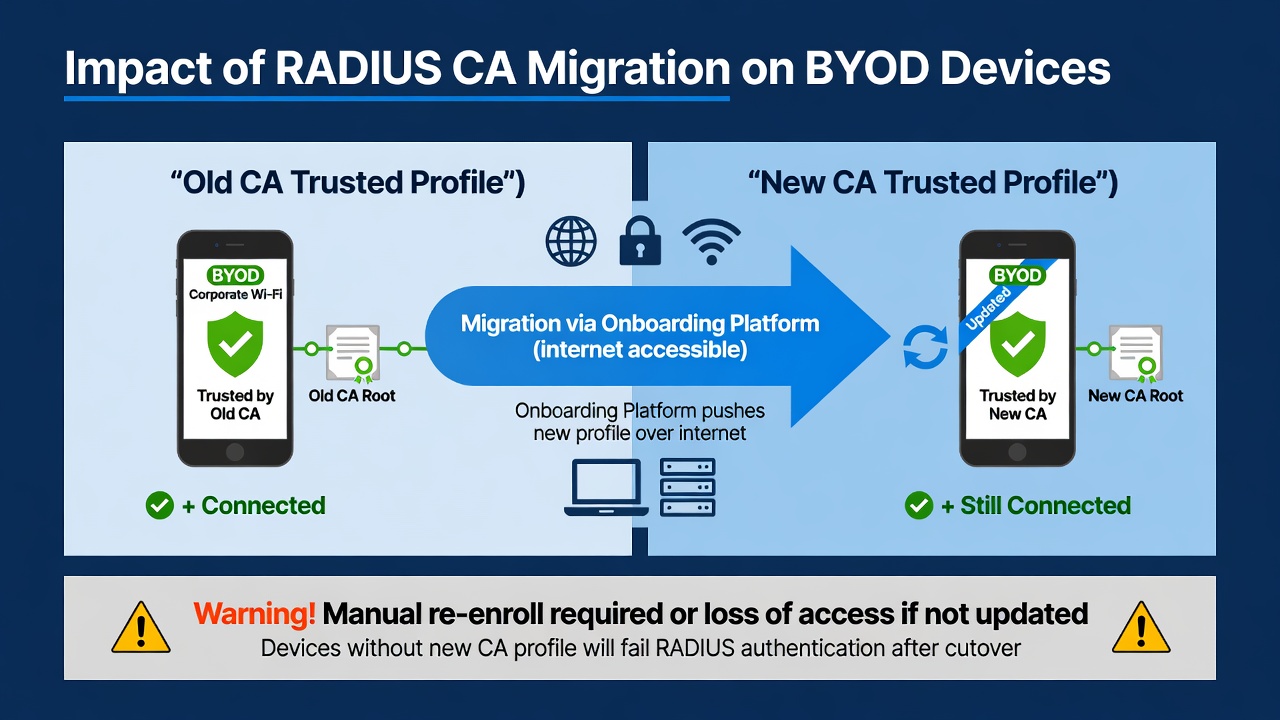
How dedicated onboarding platforms (accessible over the internet) enable mass profile updates before cutover.
Honest Limitations of Relying Only on Existing AAA Tools
Platforms like Cisco ISE have native BYOD portals and certificate provisioning. However, they are often designed around on-campus or already-connected experiences. Re-enrolling tens of thousands of off-network personal devices through native tools at the last minute is operationally unrealistic for most organizations.
Without a dedicated layer that can deliver updated profiles over the public internet (before or after the cutover), IT teams are left with manual instructions, QR codes that only work on campus, or mass helpdesk queues.
How Specialized Onboarding Platforms Change the Game
A modern cloud onboarding + dynamic PKI layer can:
- Detect devices that need updated profiles via internet-accessible portals or background checks.
- Push new supplicant profiles and trust anchors remotely, often without requiring users to be on the corporate network.
- Support bulk or staged re-enrollment campaigns with clear user communication.
- Work alongside your existing AAA (ISE or equivalent) so you keep your policy engine and only add the enrollment horsepower needed for the migration event.
For Technical Teams: Practical Migration Steps
1. Audit Now (2025)
Inventory which CA roots are currently trusted in your RADIUS servers and embedded in existing device profiles. Identify the population of devices that will be affected.
2. Establish Dual Trust
Configure your RADIUS infrastructure to trust both the old and new CA chains during the transition window. Test thoroughly.
3. Use Your Onboarding Platform for Re-Enrollment
Leverage internet-reachable enrollment flows to deliver updated profiles. Prioritize high-churn populations (students, contractors). Monitor success rates in real time.
4. Cutover and Cleanup
After the deadline, remove old trust where safe. Continue using the onboarding layer for ongoing new devices and future renewals.
Integration Notes with Existing AAA
Your ISE (or equivalent) continues to handle authentication and policy. The onboarding platform acts as the front-end enrollment and profile distribution engine. Coordinate certificate templates and revocation so both systems see the same identities.
If you have a large BYOD population or are already using (or considering) a dedicated onboarding platform alongside your AAA, now is the time to model the migration project. Request a consultation to review your current CA trust posture, device population, and tooling options for a low-drama 2026.