Deploying PKI as a Service for Quick EAP-TLS Onboarding
PKIaaS (cloud PKI / the certificate engine behind many “EAP-TLS SaaS” designs) removes the complexity of on-prem CAs. True scale still requires a dedicated onboarding solution on the infrastructure you already own.
Building and operating an internal PKI for Wi-Fi EAP-TLS is expensive, complex, and slow. PKI as a Service (PKIaaS) shifts certificate issuance, lifecycle management, and high availability to the cloud — the pattern buyers often mean when they search for EAP-TLS SaaS or cloud-managed certificates for Wi-Fi.
However, "quick EAP-TLS onboarding" at real-world scale (BYOD students, guests, contractors, clinical devices) almost always requires more than just fast cert issuance. You still need a dedicated onboarding layer that can create and deliver the full device profiles — including advanced variables such as RCOI for Passpoint — through self-service flows that work over the public internet or on-site. The combination of PKIaaS + dedicated onboarding platform on top of your existing Wi-Fi and AAA infrastructure is what delivers the speed and scale most organizations are looking for.
- • On-prem PKI (AD CS + NDES connectors, manual templating, HA, patching, expertise) is one of the biggest historical blockers to widespread EAP-TLS adoption.
- • PKIaaS removes that blocker by providing automated, cloud-hosted certificate issuance with modern protocols (SCEP, EST, ACME) and built-in lifecycle management.
- • PKIaaS alone issues certificates quickly; it does not automatically solve device profile delivery, multi-OS support, or advanced policy configuration (e.g., RCOI in Passpoint profiles — see the recent Passpoint vs Traditional Wi-Fi article).
- • The fastest, lowest-friction results come from combining PKIaaS (backend certs) with a dedicated onboarding platform (frontend profile creation, self-service delivery, internet-accessible enrollment, and advanced variable support).
- • This stack works with — and enhances — your existing access points and AAA/RADIUS (Cisco ISE, ClearPass, etc.) without requiring new Wi-Fi hardware.
- • Benefits include dramatically faster deployment timelines, lower helpdesk volume (cross-ref the helpdesk reduction article), easier scaling for university/healthcare BYOD, and stronger security posture.
- • The 2026 CA migration and ongoing device churn make automated PKI + onboarding tooling even more valuable for long-term maintainability.
The Traditional PKI Problem for EAP-TLS
Deploying certificate-based Wi-Fi authentication at scale has historically required standing up and operating an internal Public Key Infrastructure:
- Active Directory Certificate Services (or equivalent) servers
- NDES or other connectors for SCEP enrollment
- Manual certificate template design and security
- High-availability, backup, patching, and monitoring of the CA infrastructure
- Specialized staff who understand PKI deeply
This is expensive, slow to stand up, and operationally heavy — exactly why many organizations stayed on passwords or PSK even when they knew EAP-TLS was superior.
What PKI as a Service Actually Solves
Modern PKIaaS platforms move the entire certificate authority function to the cloud:
- Automated issuance and renewal via SCEP, EST, and other standard protocols
- Built-in high availability, backup, and compliance
- No need to run or patch on-prem CA servers or NDES connectors
- Policy templates and revocation (CRL/OCSP) handled by the provider
- Faster time-to-first-certificate — often days or weeks instead of months
This is a genuine leap forward for the backend of EAP-TLS. Hospitals, universities, and enterprises can get the certificates they need without building a mini-PKI team.
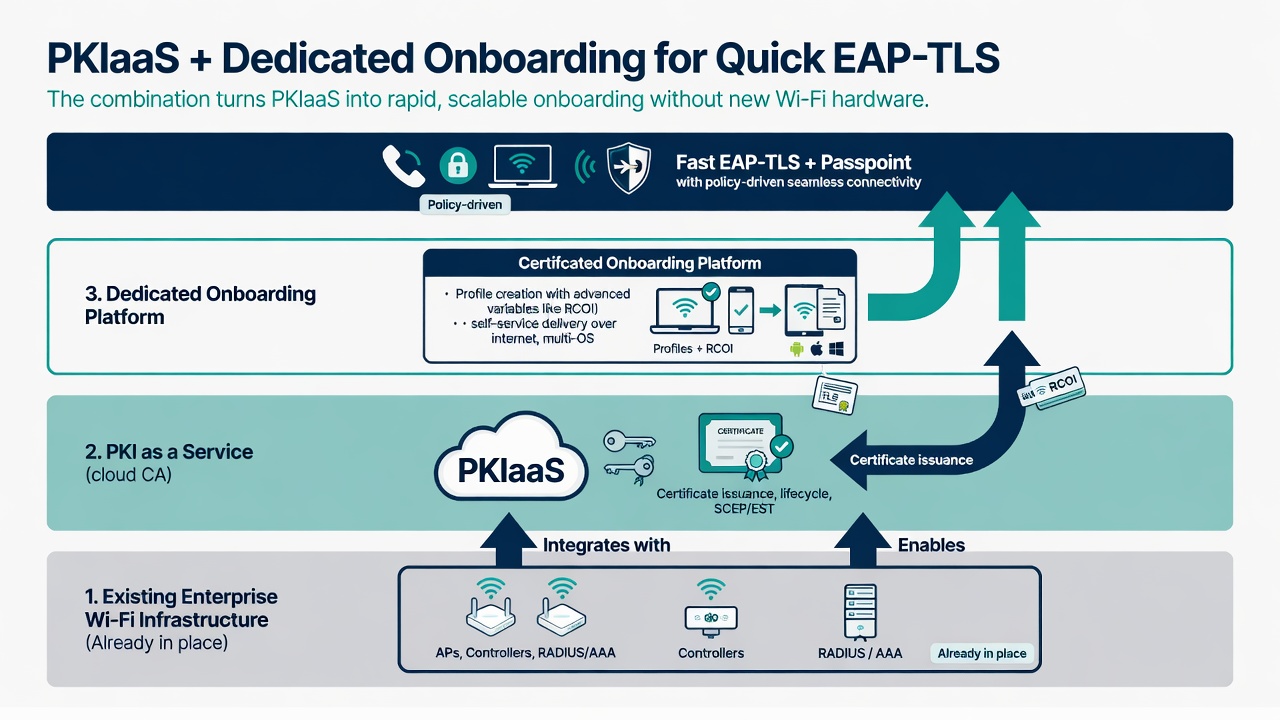
PKIaaS handles the certificates. The dedicated onboarding layer handles getting usable, policy-rich profiles onto devices quickly — on top of infrastructure you already own.
Why "Quick EAP-TLS Onboarding" Requires More Than PKIaaS
Issuing a certificate is only half the battle. For a device to actually use EAP-TLS (and especially to use Passpoint with advanced features), it needs a complete, correctly configured supplicant profile that includes:
- The client certificate and chain
- The trusted server certificate(s) for the RADIUS
- Wi-Fi network settings (SSID, security type, EAP method)
- For Passpoint: ANQP elements, RCOI (Roaming Consortium OI), NAI realms, and other policy data
PKIaaS excels at step 1 (the cert). It does not typically handle steps 2–4 at scale for unmanaged or consumer devices, nor does it provide the user-friendly, internet-accessible self-service experience that makes "quick" onboarding real for BYOD populations.
This is the exact gap that dedicated onboarding solutions close — and why they are repeatedly referenced across SecureW2, Purple, and Cloud4Wi materials as the practical enabler for certificate-based Wi-Fi (including the advanced Passpoint configurations covered in the recent Passpoint vs Traditional Wi-Fi article).
How the Combination Delivers Fast, Scalable Results
When you pair PKIaaS with a purpose-built onboarding platform:
- The PKIaaS issues and manages the certificates (SCEP/EST to MDM for managed devices; dynamic issuance for BYOD).
- The onboarding platform creates the full Passpoint/EAP-TLS profiles (including RCOI and other advanced variables), signs them with the right certs, and delivers them through guided self-service or automated flows.
- Delivery works over the public internet (pre-arrival students, remote workers, guests) or via on-site redirects — no need for the device to already be on the corporate network.
- Profiles integrate cleanly with your existing AAA/RADIUS (you keep policy control in ISE, ClearPass, etc.).
- Lifecycle (renewal, revocation on device loss or departure) is automated and tied to identity.
The result is dramatically faster time from decision to working EAP-TLS for large numbers of devices, with far lower ongoing support burden.
For Technical Teams: Implementation Patterns
Common successful patterns seen in production:
- Managed devices (Intune, Jamf, Google, etc.): PKIaaS SCEP/EST profiles pushed via MDM during device enrollment. Onboarding platform can still be used for additional Passpoint policy or as a fallback.
- BYOD / unmanaged: Self-service portal or app-based flow (internet-accessible) that authenticates the user against your IdP, triggers cert issuance from the PKIaaS, and installs the full profile with RCOI etc.
- Hybrid: Use PKIaaS + onboarding for the long tail of personal and guest devices while keeping tighter control on corporate fleets.
Key integration points: Your onboarding platform should be able to consume or proxy to the PKIaaS enrollment endpoints, pass identity context for policy decisions, and support the specific advanced Passpoint elements (RCOI) you need for your roaming or segmentation goals.
Because the stack is layered on top of existing Wi-Fi hardware and AAA, you can start small (one SSID or one population) and expand without disrupting the rest of the network.
If you are evaluating or already using PKIaaS and want to turn fast certificate issuance into genuinely quick, low-friction EAP-TLS deployment (including advanced Passpoint support), the highest-leverage work is usually assessing and implementing the dedicated onboarding layer that sits on top. Request a consultation and we can map the right integration pattern for your identity, device mix, and existing AAA.